
Quick answer: For most Australian SMEs, the decision is not about the printer’s sticker price. It is about annual part volume, technology tier, and whether you have a qualified technician. As a working rule, sustained demand below roughly 1,200 industrial-grade parts per year favours a 3D printing service bureau. Above that, with a dedicated operator already on payroll and a compliant facility, in-house industrial 3D printing starts to win on unit economics. Desktop FDM is the exception: it sits under the ATO’s $20,000 instant asset write-off threshold and pays back quickly on jigs, fixtures and concept models.
Why Australia’s answer differs from the overseas one
Most cost guides on this topic are written for American or European buyers, quote US dollars or pounds, and assume a labour market and regulatory environment that is not ours. Three things make the Australian calculation genuinely different: a manufacturing skills shortage that makes technicians hard to hire at any price, a tax concession that stops well short of industrial equipment, and a workplace exposure regime with a hard compliance date in December 2026.
The market itself is expanding quickly. Australia’s 3D printing market was valued at AUD 821.94 million in 2025 and is forecast to reach around AUD 4.56 billion by 2035, a CAGR of 18.7% across 2026 to 2035 (Expert Market Research). Institutional commitment is following. Backed by 13 Australian universities, CSIRO and more than 60 industry organisations, the Additive Manufacturing Cooperative Research Centre launched with $57.5 million in Commonwealth funding and plans to invest a further $200 million over seven years (AMCRC)
Growth does not tell an individual business whether to buy a machine. This guide works through the numbers that do.
Upload Your 3D File & Get a Quote · Speak to Our Team
Part 1: What the equipment actually costs in Australia
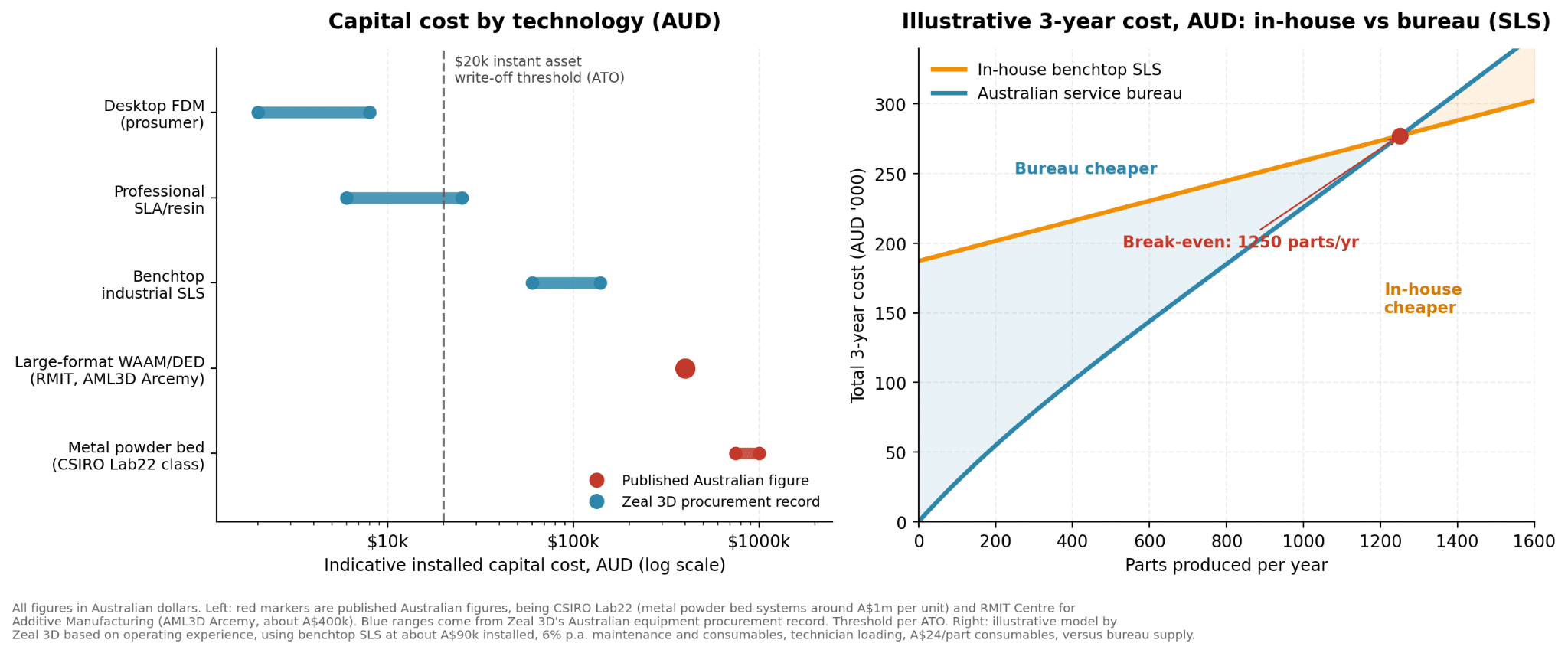
Left: installed capital cost by technology in AUD. Red markers are published Australian figures; blue ranges come from Zeal 3D’s procurement record. Right: illustrative three-year cost model. Sources appear in the figure footer.
The two hardest Australian numbers
The clearest public statement on metal additive manufacturing capital in Australia comes from CSIRO, which built an entire facility around the problem. Explaining why Lab22 exists, CSIRO’s additive manufacturing research leader noted that this class of equipment sits in the range of $1 million per unit, and the vast majority of small and medium-sized businesses do not have that capital on hand to take a leap of faith on an emerging technology (CSIRO Lab22).
That is worth pausing on. Australia’s national science agency established a shared-access facility precisely because the buy-it-yourself model does not work for SMEs at this tier. Lab22’s stated purpose is to give companies access to advanced equipment with expert support for a comparatively minimal daily fee. That is the outsourcing argument, made by CSIRO.
The large-format end has a documented Australian transaction. AML3D sold an Arcemy wire-arc additive manufacturing system to the RMIT Centre for Additive Manufacturing for approximately AU$400,000, funded through the Victorian Higher Education State Investment Fund (Metal AM).
For context on the surrounding infrastructure rather than the machine alone, RMIT’s Advanced Manufacturing Precinct is a $35 million facility (RMIT University). Machines are a fraction of what a serious additive capability costs to stand up.
Indicative installed cost by tier
| Desktop/prosumer FDM | A$2,000 to A$8,000 | Zeal procurement record | Jigs, fixtures, concept models |
| Professional SLA/resin | A$6,000 to A$25,000 | Zeal procurement record | High-detail visual models, dental, precision parts |
| Benchtop industrial SLS | A$60,000 to A$140,000 | Zeal procurement record | Functional nylon parts, short-run production |
| Large-format WAAM/DED | About A$400,000 | RMIT / AML3D, published | Large metal components, repair, defence |
| Metal powder bed (LPBF/EBM) | A$750,000 to A$1,000,000+ | CSIRO Lab22, published | Aerospace, medical implants, tooling |
Where these numbers come from. The bottom two rows are published Australian figures, linked above. The top three rows are not survey data and we do not present them as such. They come from Zeal 3D’s own equipment procurement and operating record, meaning quotes, invoices and installation costs for machines we have purchased, commissioned and run commercially in Australia over two decades. Each range is expressed as landed cost including GST, delivery, commissioning and the ancillary equipment the process requires. We publish them because no comprehensive public machine price index exists for the Australian market, and a range grounded in actual local purchases is more useful than a converted US list price. Treat them as a planning starting point rather than a quotation, because configuration, exchange rate movement and support contracts all move these figures materially.
Installed cost is not machine cost. Powder handling, sifting, recovery and cleanup stations are not accessories. An SLS or metal system cannot be operated without them. This is the most common reason a quoted machine price and a commissioned system price diverge, and it explains why the ranges above sit higher than headline advertised pricing.
Part 2: The three recurring costs SMEs underestimate
The following reflects Zeal 3D’s operating experience running FDM, SLA, SLS, MJF, PolyJet and metal systems commercially in Australia, cross-referenced against Australian regulatory requirements where they apply.
1. Maintenance and consumables
Budget in the order of 6% of installed capital annually for maintenance contracts, wear parts and consumables on industrial polymer systems. On an installation costing A$90,000, that is roughly A$5,400 a year, recurring whether the machine runs at capacity or sits idle through a quiet quarter.
Powder-bed processes add a cost that catches first-time owners. Unfused powder cannot be recycled indefinitely, because thermal cycling degrades it. Every build therefore consumes a proportion of virgin powder regardless of how much powder remains physically in the machine.
2. Facility and WHS compliance, with a December 2026 deadline
This is the line item that derails SME business cases, and in Australia it now carries a legislated date. Safe Work Australia’s Workplace Exposure Limits for airborne contaminants are being adopted into Commonwealth, state and territory WHS law from 1 December 2026. A PCBU must ensure no worker is exposed above the limit, and must conduct air monitoring where exposure is uncertain (Safe Work Australia).
Powder-bed additive manufacturing sits squarely in scope. In practice the printer is rarely the hazard, because the enclosed build chamber contains most emissions. The exposure arises in the manual steps around it: opening the chamber, depowdering, sieving, and cleaning the machine. Local exhaust ventilation, a segregated powder-handling area, air monitoring and appropriate PPE are compliance obligations, not optional extras.
If your workshop also requires a three-phase power upgrade, add five figures before commissioning. Fine polymer and metal powders carry combustible-dust and hazardous-chemical duties under the WHS Regulations, which means documented risk assessment before powder handling begins rather than after.
3. A technician you probably cannot hire
This is the most underweighted factor in Australian buy-versus-outsource analyses, and the evidence is unambiguous.
Australian manufacturing’s digital transformation remains constrained by a persistent skills gap, with roles such as robotics engineers, data analysts and CNC machinists among the hardest to fill (RSM Australia). RSM’s National Manufacturing Leader points specifically to a shortage of skilled tradespeople necessary for maintaining and operating advanced manufacturing systems, such as CNC machinists and industrial engineers (Australian Manufacturing).
The workforce is contracting rather than growing. Employment in the manufacturing industry fell by 8,700 workers, or 1%, over the year to February 2026 (Jobs and Skills Australia). In June 2026, the Manufacturing Industry Skills Alliance framed the sector’s central question as not only what Australia wants to manufacture, but whether there are enough skilled workers to do it, as demand grows across defence, advanced manufacturing and clean energy (Australian Manufacturing).
A machine you cannot staff is a depreciating asset, not a capability. If your business case depends on hiring an additive manufacturing technician, price in recruitment difficulty, a wage premium, and the risk that the person leaves. Outsourcing is one way to access that scarce skill without competing for it.
Part 3: The tax position is helpful, but not for industrial machines
Many SME purchase decisions get anchored on tax treatment, frequently incorrectly. The current position per the ATO is this. From 1 July 2026, small businesses turning over less than $10 million can write off eligible depreciating assets in full where each asset costs under $20,000. Assets priced at $20,000 or above go into the small business simplified depreciation pool instead, attracting a 15% deduction in the first income year and 30% every year after (Australian Taxation Office).
Read that against the capital table. Only desktop FDM and entry-level professional resin printers fall under the threshold. Every industrial system, meaning the tier that actually competes with bureau output quality, goes into the depreciation pool. The write-off is a genuine incentive for a machine costing A$6,000 and largely irrelevant to a decision on a system costing A$90,000.
Two traps are worth flagging. First, the total cost of the asset must be under $20,000, not merely the business-use portion. Second, the ATO notes that the rules barring small businesses from rejoining the simplified depreciation regime for five years after opting out stay suspended until 30 June 2027. This catches out more owners than you might expect, because access to the write-off depends on being inside that regime in the first place. We are not tax advisers, so confirm treatment with a registered tax agent before it shapes a purchase.
Part 4: Where break-even actually lands
The right-hand chart models a realistic Australian SME scenario using Zeal 3D’s operating assumptions: a benchtop SLS system at approximately A$90,000 installed, 6% annual maintenance and consumables, technician loading, facility overhead, and A$24 per part in consumables, set against bureau supply averaging A$102 per part and easing toward A$72 at volume.
Break-even sits near 1,250 parts per year. Below that, the bureau is cheaper on pure cash cost. Above it, in-house pulls ahead, provided utilisation holds, the facility is compliant, and the operator is already employed.
Three caveats apply. The model assumes you have somewhere compliant to put the machine and someone qualified to run it; strip either away and break-even moves sharply right. It excludes the opportunity cost of A$90,000 in capital, which for a growing SME is rarely zero. It also assumes steady demand, which is the most fragile assumption in the whole exercise.
The utilisation problem
Per-part cost in powder-bed processes is governed by how densely the build chamber is packed. A bureau nests your six parts alongside forty others from unrelated clients and amortises machine time, thermal energy and overhead across all of them. Running that same build in-house with six parts in the chamber means you pay for the empty space.
This is also why overbuying build volume is the most expensive mistake in this category. A larger chamber running the same job produces a lower utilisation ratio and therefore a higher cost per part. You pay twice: once in capital, then continuously in the energy and machine time needed to run a chamber that is mostly empty. Analyse your actual part portfolio honestly before sizing a machine.
What the community and university tier tells you about pricing
For a transparent, published Australian benchmark, UNSW’s makerspace network posts full rates. UNSW Making charges recycled PLA and PETG at $0.10 per gram, ABS at $0.16 per gram, polycarbonate at $0.20 per gram and carbon-filled nylon at $0.31 per gram, with SLS Nylon-12 at $0.20 per gram plus a $50 setup fee, and SLA resin from $0.50 per millilitre, all in AUD and GST inclusive (UNSW Making).
Those rates are useful for two reasons. They give you a real Australian floor for material-driven pricing, and they show what per-gram economics look like when capital is already sunk and subsidised.
Victorian institutions publish comparable figures. The University of Melbourne’s MSD Maker Spaces publishes commercial job rates of A$85 to A$120 per hour, and Melbourne Makerspace lists FDM filament at A$0.05 per gram (Zeal 3D: 3D Printing Cost in Melbourne). These are independent, published, GST-inclusive Australian rate cards from organisations that are not competing for commercial work, which makes them a useful sanity check on any quote you receive.
A commercial bureau prices above the university tier because it carries certification, repeatability, engineering support and guaranteed turnaround. If your requirement is genuinely a single low-criticality part, though, the institutional tier is worth knowing about.
Part 5: A decision framework
Work through these five questions in order. A “no” to any of the first three usually ends the analysis.
- Do you have sustained, predictable volume? Sporadic demand is the enemy of in-house economics. Fixed costs continue whether the machine runs or not. Three busy months and nine quiet ones will collapse utilisation and inflate per-part cost.
- Can you hire and retain a qualified operator? Not “someone technical who is interested.” Powder handling, thermal management and build-parameter tuning are learned skills. Given the shortage data above, assume this will be hard and expensive.
- Is one technology genuinely sufficient? Most business cases skip this question. Buying an FDM machine solves FDM problems. When a project needs a watertight SLA master, a nylon SLS housing or a titanium bracket, you are outsourcing again, now with capital tied up in a machine that cannot help.
- What does a failed build cost you? In-house, a failed overnight build costs machine time, material and a slipped deadline with no recourse. A bureau reprints at its own cost. For time-critical work, that risk transfer has real value.
- What is the capital opportunity cost? A$90,000 in a machine is A$90,000 not in inventory, hiring or sales.
The hybrid model most Australian SMEs land on
- Bring in-house: one or two desktop FDM machines for jigs, fixtures, workholding and fast concept iteration. This means low capital, a purchase under the ATO threshold, no specialist operator, no WHS powder exposure, and immediate turnaround.
- Outsource: everything requiring SLS, MJF, SLA, PolyJet, metal, engineering-grade materials, certified processes or dimensional guarantees.
This mirrors the logic behind CSIRO’s own Lab22 model: access the expensive capability, own the cheap one.
Where Zeal 3D fits
We are a service bureau, so treat this section as an interested party’s account. The framework above stands regardless of who you print with. That said, several features of how Zeal 3D operates map onto the cost drivers identified here.
- Access every technology without buying any. Zeal 3D runs FDM, SLA, SLS, MJF, PolyJet and SLM/DMLS metal across 45+ materials, which answers Question 3 directly.
- No minimum order quantity, no lock-in contracts. Since fixed-cost recovery is what kills low-volume in-house economics, the ability to order a single part at rational pricing is the substantive difference. Zeal’s instant quoting returns cost, lead time and DFM feedback on upload. That DFM step matters, because build orientation and support strategy often move part cost more than material choice does.
- WHS burden stays with us. Powder handling, exhaust ventilation, air monitoring and combustible-dust controls are our compliance obligation, not a capital project on your site ahead of a December 2026 deadline.
- Turnaround that competes with ownership. FDM parts ship within 24 hours. SLA, SLS, MJF, SLM and metal parts typically run 5 to 6 working days, subject to part complexity and machine availability.
- Capability beyond printing. We offer 3D scanning and reverse engineering for legacy parts, 3D CAD design, FEA and CAE analysis, and downstream CNC machining, vacuum casting and injection moulding when volumes outgrow additive.
- Two decades in Australian industrial supply chains, including CSIRO, BHP, Thales, NSW Government, Monash and RMIT. This is the segment where process control and repeatability, not machine access, is the real barrier.
Zeal 3D delivers Australia-wide from Melbourne, including Sydney, Brisbane, Perth, Adelaide, Canberra and Tasmania. For job-level pricing, see our 3D printing cost in Australia guide.
When we would tell you to buy the machine: consistent high-volume demand in a single technology, an operator already on staff, non-critical tolerances, and a facility that can host it compliantly. That combination exists. It is simply rarer than printer vendors suggest.
Upload Your 3D File & Get a Quote · Speak to Our Team
Frequently Asked Questions
Q1. Is it cheaper to buy a 3D printer or use a 3D printing service in Australia?
For most Australian SMEs, a service bureau is cheaper below roughly 1,200 industrial-grade parts per year. Above that, with an existing qualified technician, a compliant facility and consistent utilisation, in-house production becomes more cost-effective. Desktop FDM is the exception. At between A$2,000 and A$8,000 it sits under the ATO instant asset write-off threshold and pays back quickly for jigs, fixtures and concept models.
Q2. How much does an industrial 3D printer cost in Australia?
CSIRO has stated that metal additive manufacturing systems of the class housed at its Lab22 facility sit in the range of $1 million per unit. At the large-format end, RMIT’s Centre for Additive Manufacturing acquired an AML3D Arcemy wire-arc system for approximately AU$400,000. Benchtop industrial SLS typically lands between A$60,000 and A$140,000 installed, and professional resin systems between A$6,000 and A$25,000. These last two ranges are drawn from Zeal 3D’s own Australian equipment procurement record rather than published survey data.
Q3. Does the instant asset write-off cover a 3D printer?
Only if the asset costs less than $20,000, your business has aggregated turnover under $10 million, and you use simplified depreciation rules. That covers desktop FDM and entry-level resin printers. Industrial SLS, MJF and metal systems all sit well above the threshold, so they are pooled instead and depreciated at 15% in the first income year and 30% in each year after that. Confirm treatment with a registered tax agent.
Q4. What WHS obligations apply to in-house 3D printing in Australia?
Safe Work Australia’s Workplace Exposure Limits for airborne contaminants are being adopted into Commonwealth, state and territory WHS law from 1 December 2026. A PCBU must ensure no worker is exposed above the limit and must conduct air monitoring where exposure is uncertain. For powder-bed processes this typically means local exhaust ventilation, a segregated powder-handling area, combustible-dust controls and appropriate PPE.
Q5. Why is 3D printing cheaper per part at a service bureau?
Bureaus nest parts from multiple clients into a single build chamber, amortising machine time, thermal energy and overhead across many jobs. They also spread technician labour, maintenance and facility compliance costs across far greater volume, and they buy material in bulk. An in-house machine running partially filled builds absorbs those fixed costs alone.
Q6. Can I use both in-house 3D printing and a service bureau?
Yes, and most Australian SMEs that get this right do. The common pattern is desktop FDM in-house for jigs, fixtures and rapid concept iteration, with SLS, MJF, SLA, PolyJet and metal work outsourced. This keeps capital low and WHS exposure minimal while preserving access to every technology and material grade.
The bottom line
The buy-versus-bureau decision is not primarily a cost comparison. It is a capability and utilisation question that resolves into cost. Australian SMEs consistently underestimate three things: how much of the total sits outside the machine price, how difficult it is to staff an industrial additive process in a contracting manufacturing labour market, and how often a single technology fails to cover the range of parts a business actually needs.
CSIRO reached the same conclusion at national scale and built Lab22 around it. Run the five questions. If you clear all five, buy the machine. If you stall on any of them, a 3D printing solution delivered through a bureau gives you the same output without the capital, the recruitment problem, the compliance project, or the risk of owning a machine that no longer matches what you need to make.
Sources
All sources below are Australian, or report Australian transactions and figures in AUD.
- Australian Taxation Office: $20,000 Instant Asset Write-Off
- Safe Work Australia: Workplace Exposure Limits for airborne contaminants
- CSIRO: Lab22, Australia’s centre for innovation in metallic additive manufacturing
- Jobs and Skills Australia: Manufacturing Industry Profile
- UNSW Making: 3D Print Pricing
- RMIT University: Advanced Manufacturing Precinct
- Metal AM: Australia’s RMIT adds AML3D’s Arcemy AM machine
- Additive Manufacturing Cooperative Research Centre: AMCRC
- RSM Australia: Australian Manufacturing 2026 to 2027
- Australian Manufacturing: Manufacturing goals are clear, but skills shortages remain the bottleneck
- Australian Manufacturing: Bridging the skills gap
- Expert Market Research: Australia 3D Printing Market 2026 to 2035
- University of Melbourne MSD Maker Spaces and Melbourne Makerspace published rate cards, as compiled in Zeal 3D: 3D Printing Cost in Melbourne
Disclaimer: All monetary figures are in Australian dollars. Capital ranges marked “Zeal procurement record” are derived from Zeal 3D’s own purchase, commissioning and operating costs for equipment run commercially in Australia. They are indicative planning figures, not published survey data and not a quotation. Tax commentary is general information only and is not tax advice, so consult a registered tax agent. WHS commentary is general and does not substitute for a workplace-specific risk assessment. Zeal 3D Printing Services is a commercial 3D printing provider and therefore an interested party in this comparison.