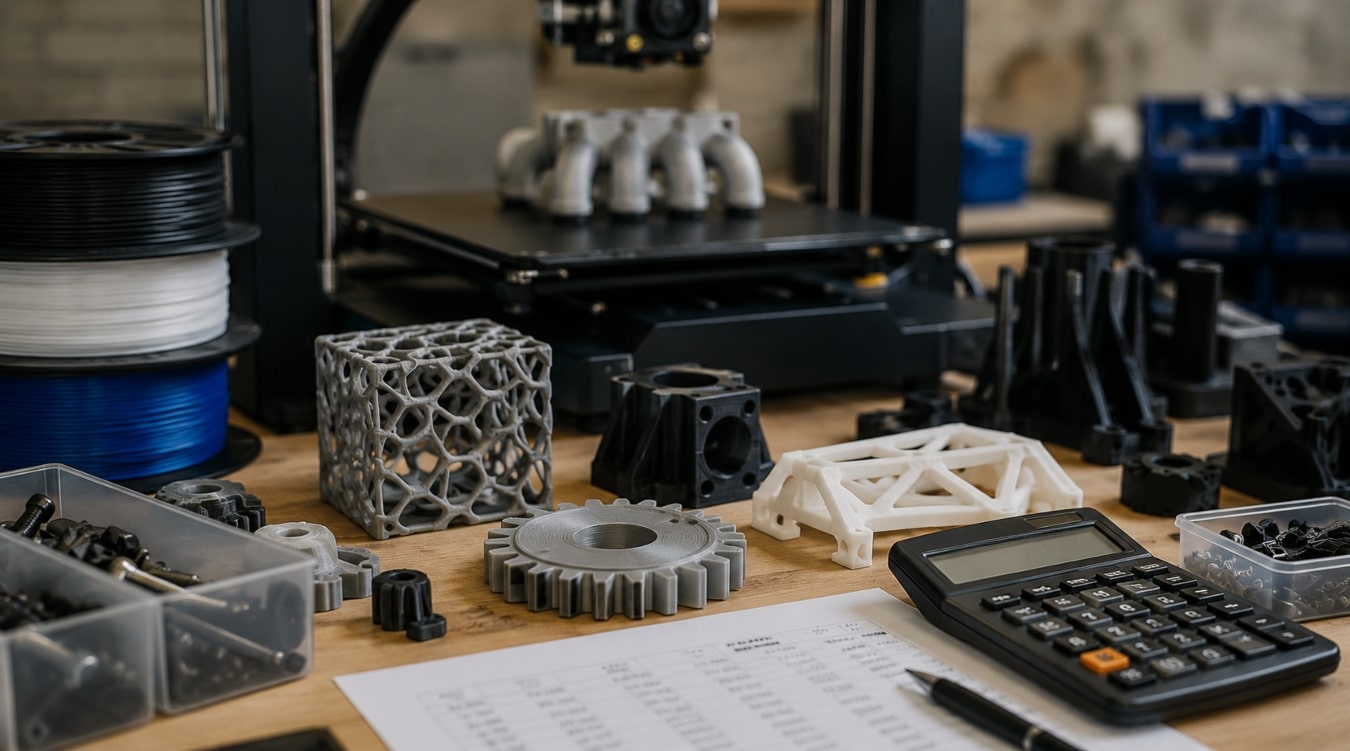

In Perth, professional 3D printing costs range from around A$40 for a simple FDM prototype to A$10,000+ for large industrial metal components. (Source 1) Between those extremes sit resin (SLA), nylon (SLS/MJF), and metal (DMLS) parts, each priced differently depending on material, part size, quantity, and finishing. Because Perth has fewer local providers than Melbourne or Sydney, most jobs run 10–20% higher than east-coast pricing — though for many parts, freight from a national provider still beats that premium.
This guide breaks down exactly what Perth businesses, engineers, procurement teams, mining contractors, and product developers can expect to pay in 2026, and where the real savings are.
Upload Your File & Get a Free Quote · Speak to a Perth Engineer
Quick answer: 3D printing in Perth costs A$40–A$180 for standard FDM plastic parts, A$130–A$600 for high-detail SLA resin, A$350–A$1,800 for industrial SLS nylon, and A$600–A$10,000+ for metal 3D printing (DMLS/SLM). Batch orders and standing accounts bring per-unit costs down significantly. Get a free quote →
3D Printing Price Guide by Technology (Perth, 2026)
Figures below are indicative for a medium-complexity part (roughly 100 × 100 × 50 mm). Actual quotes depend on geometry, quantity, material grade, and finishing.
| Technology | Material | Prototype / 1-off | Batch (10–50 pcs) | Typical Lead Time in Perth | Best for |
|---|---|---|---|---|---|
| FDM | PLA, PETG, ABS, Nylon, PC | A$40 – A$180 | A$20 – A$100 / pc | 2–4 days | Concept models, jigs, tooling aids, mining housings |
| SLA (Resin) | Standard, ABS-like, castable | A$130 – A$600 | A$70 – A$300 / pc | 3–5 days | High-detail prototypes, patterns, presentation models |
| SLS (Nylon) | PA12, PA11, glass-filled | A$350 – A$1,800 | A$180 – A$700 / pc | 4–7 days | Functional, chemically resistant parts for mining & industrial use |
| MJF | PA12, PA11, TPU | A$400 – A$1,900 | A$180 – A$750 / pc | 4–6 days | Production-grade nylon, consistent short-run batches |
| Metal (DMLS/SLM) | 316L stainless, Ti64, AlSi10Mg | A$600 – A$10,000+ | POA — volume dependent | 7–14 days | Mining spares, oil & gas fittings, aerospace, defence brackets |
Indicative ranges only. Request a formal quote for accurate, project-specific pricing.
Why Perth 3D Printing Costs More Than Melbourne or Sydney
Two things drive the WA premium, and neither is really about the printing itself:
- Fewer local providers. Perth’s additive manufacturing market is smaller than Melbourne’s or Sydney’s, so there’s less competitive pressure on price, and shops carry less spare machine capacity to discount into. A handful of Perth-based providers compete for the same pool of engineering and mining clients.
- Freight and logistics. Whether you print locally or use an east-coast provider, materials, spare parts, and specialised powders (titanium, stainless steel) typically travel further to reach WA, and finished parts travelling to remote mine sites or ports add further cost.
In practice, this means the technology and material you choose still matters far more than your postcode — the gap between FDM and SLS pricing is much larger than the gap between Perth and Melbourne pricing for the same part. National providers like Zeal 3D that ship to WA on 2–4 day express freight can often offset the local-provider premium entirely, particularly for SLS, MJF, and metal parts where WA-specific machine capacity is limited.
What Determines Your Perth 3D Printing Quote
- Print technology. This is the single biggest cost lever. An FDM jig and an SLS jig in the same nylon can differ 4–5× in price purely because of the process. Use FDM for non-cosmetic functional parts, SLS/MJF for production-grade nylon, and metal only where mechanical performance or corrosion resistance demands it.
- Material selection. Standard PLA and PETG run A$20–A$30/kg. Engineering resins and glass-filled or carbon-fibre nylon run A$70–A$150/kg. Metal powders- 316L stainless, titanium- can cost several hundred dollars per kilogram, which shows up directly in per-part pricing.
- Part size and geometry. Pricing is generally tied to the bounding box the part occupies during the build, not just its weight. Hollowing non-structural sections and reducing wall thickness where structurally acceptable can cut costs by 20–40%.
- Resolution and finish. Finer layer heights improve surface quality but add print time. For internal brackets or housings, specifying a coarser resolution at the quoting stage is a straightforward saving.
- Support structures. Parts with heavy overhangs need more support material and post-processing labour. A short design-for-additive-manufacturing (DfAM) review can often remove the need for supports entirely.
- Post-processing. Standard finishing (support removal, light sanding) is usually included. Painting, anodising, vapour smoothing, and inspection reports are charged as add-ons and can represent 30–50% of total job cost on high-finish batch orders. Peer-reviewed 2025/26 research on metal powder-bed 3D printing confirms this pattern at a technical level too: a discrete-event-simulation costing study published in npj Advanced Manufacturing found post-processing activities and part geometry are among the biggest drivers of total manufacturing cost, alongside production rate. (Source 2)
- Order quantity. A single SLS part might run A$400–A$600; the same part in a batch of 50 can fall to A$180–A$220 per unit as setup costs and build-chamber space get shared across the run.
3D Printing for Perth’s Key Industries
Perth’s manufacturing demand looks different from Melbourne’s or Sydney’s, and that shapes which materials and technologies actually make sense here.
- Mining and resources. WA’s dominant industry needs durable, chemically resistant parts — think impeller housings, conveyor guides, and replacement jigs that can survive dust, moisture, and abrasive conditions. Glass-filled nylon (SLS) and engineering-grade FDM materials are the usual choice, with metal DMLS reserved for load-bearing or high-wear components. Businesses around Perth’s industrial precincts- Malaga, Welshpool, Kewdale, and Bibra Lake— frequently use 3D printing to get replacement parts on-site fast rather than waiting weeks for a traditional casting or machined part. This isn’t just an industry anecdote: mining-grade additive manufacturing is a formally funded WA research priority, discussed further below.
- Oil, gas, and marine. WA energy operators and the marine/subsea trades around Henderson and Kwinana need corrosion-resistant, high-strength components for offshore and coastal environments. Stainless steel and titanium DMLS parts, along with chemically resistant nylon, are common here, facing the same corrosion challenges that Curtin University’s Corrosion Centre is researching under the national AMCRC program (see below).
- Defence and aerospace. Perth’s defence sector (supporting HMAS Stirling and related contractors) uses metal 3D printing for lightweight brackets and low-volume replacement components where traditional tooling isn’t cost-effective for small batch sizes. A recent local example of the speed advantage: in May 2026, WA-based Hyperion Systems unveiled the Astra 460, the Southern Hemisphere’s first 3D-printed uncrewed surface vessel — at the Indian Ocean Defence and Security Conference in Perth. Its hull was printed in roughly 40 hours using large-format additive manufacturing and recycled polymer, compared with 4–6 weeks for a traditionally built hull. (Source 3)
- Construction and architecture. Perth’s design and construction firms use FDM and SLA for scale models and presentation pieces, with lower cost tolerance requirements but higher emphasis on turnaround and finish.
Perth’s Growing Role in Australia’s Additive Manufacturing Sector
Demand for 3D printing in WA isn’t just commercial momentum; it’s backed by government and university research investment centred in Perth. In April 2025, Curtin University was named a lead partner in the Additive Manufacturing Cooperative Research Centre (AMCRC), a $271 million national initiative funded with $58 million from the Australian Government’s Cooperative Research Centres program. (Source 4) Researchers from Curtin’s John de Laeter Centre and Curtin Corrosion Centre are running AMCRC projects specifically on mining, agriculture, and marine-grade additive manufacturing, the exact materials science challenges (corrosion resistance, durability in abrasive conditions) behind most commercial 3D printing demand in WA.
Nationally, this sits alongside broader institutional backing: Standards Australia has adopted the international standard AS ISO/ASTM 52900:2023 to formalise additive manufacturing terminology and quality definitions, (Source 5) and CSIRO operates Lab22, the national centre for metallic additive manufacturing innovation. (Source 6) Australia’s manufacturing sector as a whole contributes roughly $100 billion to GDP and employs around 900,000 people, the base from which additive manufacturing adoption is growing. (Source 5)
That research relationship is active and expanding through 2026, not just a one-off announcement. In July 2026, Austal, the shipbuilder headquartered at Henderson, in Perth’s marine industrial precinct, and prime contractor for the US Navy’s own Additive Manufacturing Centre of Excellence, commenced an 18-month, $600,000 collaborative project with Curtin University and the AMCRC to build a practical framework for identifying which naval and maritime components are commercially worth 3D printing. (Source 7) That same month, the AMCRC also launched its STARTER funding program: $3.25 million in dollar-for-dollar co-funding (A$20,000–A$75,000 per project) to help Australian SMEs and start-ups trial additive manufacturing in their own supply chains. (Source 8) Together, these point to sustained rather than one-off investment in WA’s additive manufacturing capability.
6 Ways to Reduce 3D Printing Costs in Perth
- Batch your orders. Combine multiple parts into a single build run rather than ordering one-off. A build chamber packed with 50 parts costs far less per unit than 50 separate jobs — this matters even more in Perth, where fewer local providers means less spare capacity to negotiate around.
- Hollow non-structural parts. A solid housing can cost 3–4× more in material than the same part hollowed with 2mm walls. Ask for a design review before quoting.
- Match the technology to the job. Don’t specify SLS or metal printing for an early concept model that FDM will do for a fraction of the price.
- Reduce support dependency. Redesigning overhangs beyond 45° or adding self-supporting geometry cuts material use and post-processing labour.
- Loosen tolerances where you can. Tight tolerances (±0.05mm) cost far more in machine time and inspection than ±0.1mm. Mark only the dimensions that actually need precision.
- Use a national provider with WA freight. For SLS, MJF, and metal parts especially, a provider shipping into Perth on 2–4 day express freight can beat local pricing once you account for the smaller Perth provider pool.
Frequently Asked Questions: 3D Printing Cost in Perth
How much does 3D printing cost in Perth?
Perth 3D printing costs range from around A$40 for a simple FDM plastic prototype to A$10,000+ for large or complex metal components. Most standard prototypes fall between A$100 and A$1,800 depending on the technology used.
Is 3D printing more expensive in Perth than Melbourne or Sydney?
Generally yes, by around 10–20%, mainly due to fewer local providers and freight logistics rather than higher production costs. The gap is small compared to the price difference between technologies — choosing FDM over SLS saves far more than switching cities.
What’s the cheapest 3D printing technology available in Perth?
FDM (Fused Deposition Modelling) is the most affordable, starting around A$40 per part for standard thermoplastics like PLA, PETG, or ABS. It suits concept models, jigs, and non-cosmetic functional parts.
How much does metal 3D printing cost in Perth?
Metal 3D printing (DMLS/SLM) in Perth typically starts around A$600–A$2,000 for small stainless steel or aluminium parts and can exceed A$10,000 for large or complex titanium components, reflecting metal powder costs and mandatory post-processing.
How long does 3D printing take in Perth?
Standard lead times are 2–4 days for FDM and SLA, 4–7 days for SLS and MJF, and 7–14 days for metal DMLS. National providers with WA freight typically add 1–3 business days for delivery.
Can I get volume discounts on 3D printing in WA?
Yes. Batching 10 or more identical parts, or combining several different parts into one SLS or MJF build, meaningfully lowers per-unit cost. Businesses with recurring orders can also set up standing accounts for corporate pricing.
Should a Perth business buy a 3D printer or outsource?
For most WA businesses, outsourcing is more cost-effective. Industrial SLS and metal printers cost hundreds of thousands of dollars and require dedicated operators and controlled environments. Outsourcing gives access to FDM, SLA, SLS, MJF, and metal printing without the capital outlay.
Get a Free Quote for Your Perth Project
Zeal 3D serves Perth and Western Australia from a dedicated West Perth office, with 2–5 day turnaround, free design assistance, and no minimum order quantity — from mining spares to defence-grade metal components.
Quote within 24 hrs · WA delivery 2–4 days · 6 technologies available · 1300 719 729
Upload Your 3D File & Get a Quote · Speak to Our Perth Team
Sources & methodology
[1] Pricing data. Ranges in this guide are cross-checked against multiple sources rather than a single figure: Zeal 3D’s own published national pricing data, including the Western Australia row of our Australia 3D printing cost guide (FDM A$40–A$180, SLA A$130–A$600, SLS A$350–A$1,800, metal DMLS A$600–A$10,000+), plus other publicly available Australian 3D printing pricing guides for comparison. Where sources diverged, we used the overlapping range rather than the widest or narrowest figure.
[2] Peer-reviewed cost research. Büşra Karaş & Alborz Shokrani Chaharsooghi, “Activity-based costing of laser powder-bed additive manufacturing incorporating discrete event simulation”, npj Advanced Manufacturing, vol. 2, article 24 (2025) — peer-reviewed study (Nature Portfolio) confirming post-processing, part geometry, and production rate as major cost drivers in metal additive manufacturing.
[3] Hyperion Systems / IODS 2026. “Hyperion Shows 3D Printed Astra 460 USV, TitanCell ‘Factory In A Box’ At IODS 2026”, Naval News, May 2026 — industry trade press coverage of the WA-built, 3D-printed vessel and its build time versus traditional methods.
[4] Curtin University / AMCRC. “Curtin to drive innovation in $271M national additive manufacturing initiative”, Curtin University media release, 30 April 2025 — confirms Curtin’s role in the Additive Manufacturing Cooperative Research Centre and its focus on mining, agriculture, and marine-grade AM, funded by the Australian Government’s Cooperative Research Centres program.
[5] Standards Australia. “Unlocking the potential of 3D printing in Australia”, Standards Australia — source for the AS ISO/ASTM 52900:2023 standard and Australian manufacturing sector GDP/employment figures.
[6] CSIRO. Lab22 — Australia’s centre for innovation in metallic additive manufacturing, CSIRO — national government science agency confirming CSIRO’s role in metallic additive manufacturing R&D.
[7] Austal / Curtin / AMCRC, July 2026. “Austal backs framework to accelerate additive manufacturing for Australia’s maritime and defence industry”, Marine Business News, 8 July 2026 — confirms the $600,000, 18-month Austal–Curtin–AMCRC framework project and Austal’s Henderson, WA base.
[8] AMCRC STARTER funding. “$3.25 million funding program to help SMEs and start-ups unlock additive manufacturing”, AMCRC, July 2026 — official program page confirming funding amount, co-funding structure, and eligibility.
As with any indicative guide, treat pricing figures as planning estimates — get a formal quote for project-specific pricing.
Pricing disclaimer
All prices on this page are indicative market ranges for planning purposes only and do not constitute a formal quotation. Final pricing depends on part geometry, material grade, finish requirements, order quantity, and current raw material costs. Submit your 3D files via our online portal or contact our team for a formal written quote.