
Brisbane is entering an infrastructure cycle unlike anything Queensland has experienced before. With the 2032 Olympic and Paralympic Games less than a decade away, the state’s construction, engineering, and manufacturing sectors are gearing up for a delivery program that the Games Independent Infrastructure and Coordination Authority (GIICA) has described as the largest infrastructure investment in Queensland’s history. New stadiums, athlete villages, transport links, and precinct redevelopments are moving from concept to construction documentation at a pace that traditional manufacturing supply chains will struggle to match.
This is where 3D printing in Brisbane has a genuine, practical role to play — not as a novelty, but as a manufacturing method that solves real bottlenecks in design validation, prototyping, signage, and component production. At Zeal 3D, we work with engineers, architects, and contractors across South East Queensland, and we are seeing early but clear demand for 3D printing services in Brisbane that can support Games-related projects from concept through to delivery.
This article looks at where additive manufacturing fits into the Brisbane 2032 infrastructure pipeline, the technical considerations for using 3D print Brisbane services on time-critical projects, and how local businesses can position themselves for the procurement opportunities ahead.
The Scale of the Challenge — and Why Timelines Matter
The Brisbane 2032 Delivery Plan, released by the Queensland Government following GIICA’s review process, sets out an ambitious schedule: new and upgraded venue design and construction running from 2025 through 2028, with temporary infrastructure procurement and operational planning continuing through to 2031. The Games themselves — the Olympics from 23 July to 8 August 2032, and the Paralympics from 24 August to 5 September 2032 — will be hosted not just in Brisbane but across Moreton Bay, the Sunshine Coast, the Gold Coast, Redlands, and regional centres including Toowoomba, Townsville, Cairns, Rockhampton, and Maryborough.
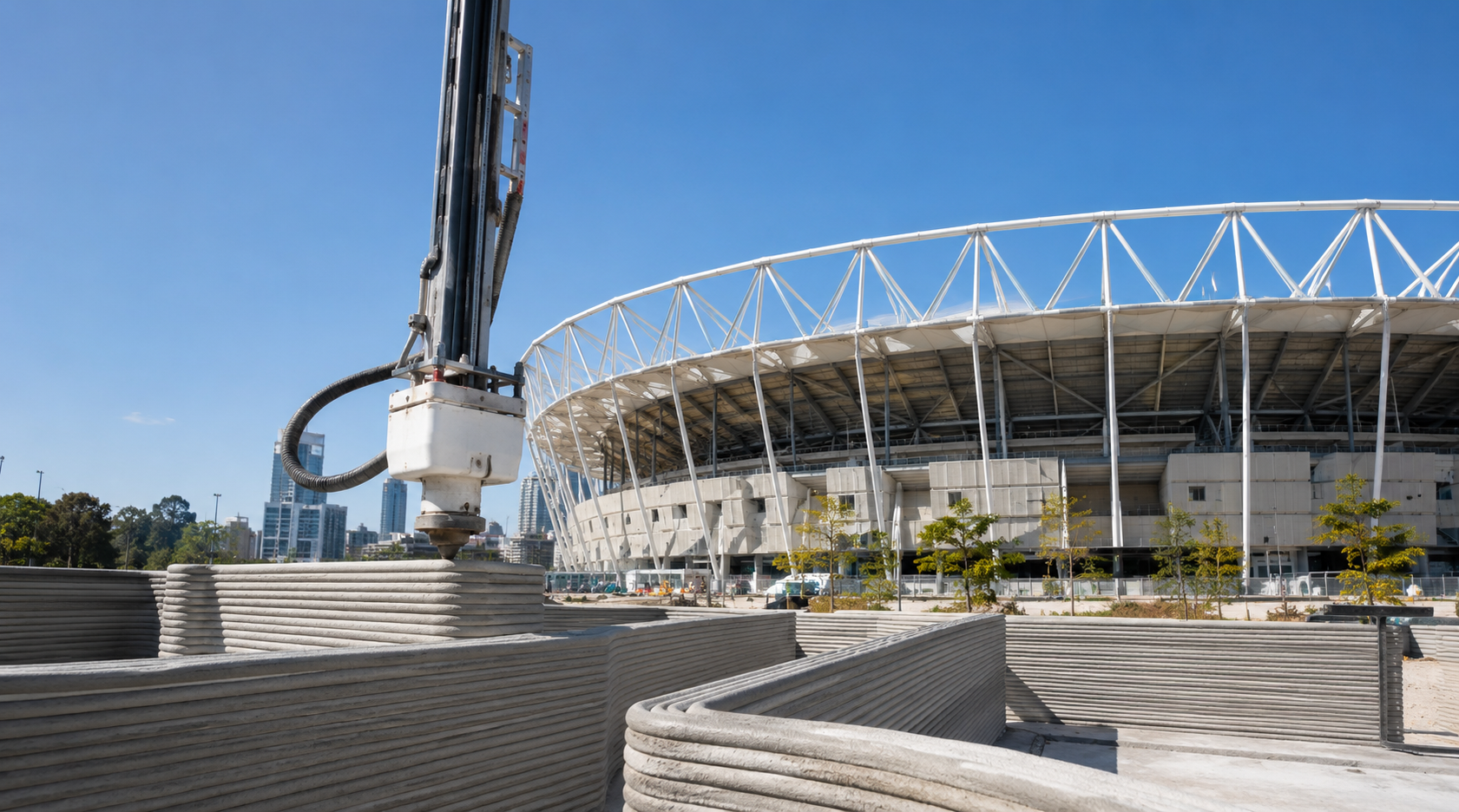
Major projects already on the books include the redevelopment of the Brisbane Cricket Ground (the Gabba) in Woolloongabba as the primary stadium for athletics and the opening and closing ceremonies, a new inner-city Brisbane Arena for swimming and basketball events, and the Moreton Bay Indoor Sports Centre — a nine-court community sports hub designed for boxing during the Games and ongoing community use afterward.
For an engineering or construction business, a project pipeline of this size and on this timeline creates a specific problem: traditional manufacturing methods — CNC machining, injection moulding, sheet metal fabrication — all require tooling, setup time, and minimum order quantities that don’t suit the iterative, fast-moving nature of early-stage design work. When a design changes (and on a project this size, it will change repeatedly), waiting two to three weeks for a new tooled prototype isn’t viable.
This is precisely the gap that 3D printing Brisbane 2032 projects are starting to fill.
Where Additive Manufacturing Fits Into Olympic-Scale Projects
1. Architectural Scale Models for Venue Design and Council Approval
Every major venue redevelopment — from the Gabba to the new Brisbane Arena — goes through multiple rounds of design review, stakeholder presentation, and council approval before construction documentation is finalised. Physical scale models remain one of the most effective tools for communicating spatial design intent to non-technical stakeholders, and they are far faster to produce using 3D printing in Brisbane than traditional model-making techniques.
Using SLA (stereolithography) resin printing, architectural firms can produce highly detailed scale models with smooth surfaces, fine architectural detailing down to handrails and facade panelling, and accurate representation of complex geometric forms — stadium roof structures being a particularly relevant example given the engineering complexity of large-span roof designs.
For a firm working on Games-related design submissions, the practical advantage is turnaround. A 3D printed scale model that previously took two to three weeks to commission from a specialist model-maker can be produced in 2–5 business days through an industrial 3D printing service in Brisbane, with the ability to iterate quickly when design revisions come through — which, on a project of this scale, happens often.
2. Custom Components for Modular and Offsite Construction
One of the consistent themes in the industry commentary around Brisbane 2032 delivery is the shift toward modular construction, offsite manufacturing, and preassembled components — approaches that lift efficiency, accelerate build programs, and reduce on-site labour demand at a time when the construction sector is already under significant strain from competing major projects.
Modular and offsite construction relies heavily on standardised connection details, brackets, fixings, and custom hardware that need to be validated before mass production. This is a natural fit for additive manufacturing Brisbane capabilities. FDM (Fused Deposition Modelling) printing in engineering-grade thermoplastics such as ABS, ASA, and Nylon PA12 allows fabricators to produce functional prototypes of custom brackets, jigs, and connection components — testing fit, tolerance, and assembly sequence before committing to production tooling or CNC-machined originals.
Where the final component needs to be metal — structural brackets, load-bearing connectors, or fixings exposed to weather — metal 3D printing Brisbane services using DMLS (Direct Metal Laser Sintering) in stainless steel 316L or aluminium AlSi10Mg can produce fully dense, mechanically tested components. For low-volume, highly specific connection details that don’t justify a casting or forging run, DMLS often works out more cost-effective than traditional metal manufacturing once tooling and setup costs are factored in.
3. Wayfinding, Signage and Branded Environment Prototypes
Wayfinding and signage are easy to underestimate in a project of this scale, but with venues spread across five regions and multiple host cities, consistent, legible, and durable signage systems are a significant design and procurement category in their own right.
3D printed lettering, mounting brackets, and signage components allow signage manufacturers and fit-out contractors to prototype font legibility, mounting mechanisms, and weatherproofing details before committing to large production runs. Materials such as ASA — chosen specifically for its UV resistance — are well suited to outdoor signage prototypes that need to survive Queensland’s climate during testing phases.
For Brisbane-based signage and fit-out businesses preparing for Games-related tender opportunities, having an established relationship with a local 3D printing service Brisbane provider means design iterations can happen in days rather than weeks — a meaningful advantage when tender response windows are tight.
4. Engineering Prototypes and Jigs for Temporary Infrastructure
A significant proportion of Games infrastructure is temporary by design — overlay infrastructure, temporary seating structures, broadcast facilities, and event-specific fit-outs that are installed before the Games and removed afterward. Temporary infrastructure projects are particularly well suited to additive manufacturing because the components are, by definition, not intended for long-term production runs.
Engineering teams working on temporary structures can use 3D print Brisbane services to produce assembly jigs, alignment tools, and test fixtures that speed up on-site installation — particularly valuable when installation windows are compressed, as they typically are for event infrastructure that needs to be erected, used, and dismantled within defined timeframes.
SLS (Selective Laser Sintering) nylon printing is particularly useful here. SLS parts require no support structures, can be produced in batches without per-unit tooling costs, and the PA12 nylon material offers good mechanical durability for repeated-use jigs and fixtures across an installation program spanning multiple venues.
5. Replacement Parts and MRO Support for Construction Equipment
With construction activity ramping up across multiple sites simultaneously, equipment downtime becomes a genuine cost driver. A cracked housing, a worn bracket, or a discontinued part for older plant equipment can hold up a work crew for days while a replacement is sourced from interstate or overseas suppliers.
Local 3D printing Brisbane capability provides a practical maintenance, repair, and operations (MRO) solution. Reverse engineering a worn or broken part using 3D scanning, followed by reproduction in an appropriate material — engineering-grade nylon for housings and guards, or DMLS metal for load-bearing replacement components — can return equipment to service in days rather than the weeks a freight-dependent replacement part might take.
Materials That Meet Olympic-Grade Engineering Standards
Infrastructure projects of this profile — with public scrutiny, safety certification requirements, and long-term legacy use considerations — demand materials that perform to documented engineering standards, not just “good enough for a prototype” thermoplastics.
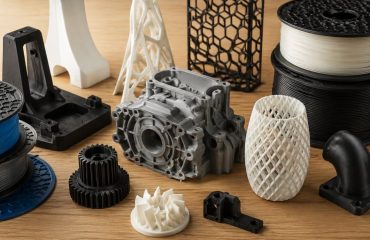
The material range relevant to Games-related applications spans:
- ABS and ASA — durable, UV-stable thermoplastics suited to signage components, enclosures, and outdoor fixtures. ASA’s UV resistance makes it the preferred choice over standard ABS for anything exposed to sunlight.
- Nylon PA12 (SLS) — strong, flexible, and impact-resistant, ideal for jigs, fixtures, and functional components that need to withstand repeated handling across a multi-venue installation program.
- Carbon Fibre Reinforced Nylon — for components where stiffness-to-weight ratio matters, such as lightweight structural elements in temporary overlay infrastructure.
- High-detail SLA resin — for architectural scale models requiring fine surface detail and dimensional accuracy suitable for stakeholder presentations and council submissions.
- Stainless Steel 316L and Aluminium AlSi10Mg (DMLS) — for structural brackets, fixings, and load-bearing connectors requiring fully dense metal parts with documented mechanical properties.
Choosing the right material for a Games-related component isn’t just a question of cost — it’s a question of matching the material’s documented properties to the application’s load, environmental exposure, and certification requirements. This is where working with an experienced 3D printing service in Brisbane that understands both the technology and the materials science becomes genuinely valuable, rather than simply outsourcing to the cheapest available print bureau.
The SME Procurement Opportunity Through Gateway by ICN
For Brisbane-based manufacturing, engineering, and design businesses, the 2032 Delivery Plan represents more than just a backdrop — it’s a direct procurement opportunity. Queensland Government procurement for Games-related infrastructure is explicitly structured to prioritise local industry participation, with a stated focus on Queensland and Australian suppliers, particularly small and medium enterprises.
Businesses interested in supplying goods or services related to Brisbane 2032 infrastructure can register an Expression of Interest through Gateway by ICN, the dedicated platform for Queensland Government Games-related procurement. The process involves registering, completing an EOI questionnaire, and — for shortlisted businesses — progressing to a closed tender process that typically includes an in-person pitch presentation.
For businesses considering this pathway, having a track record of fast-turnaround prototyping and low-volume production — exactly the kind of work that additive manufacturing Brisbane providers like Zeal 3D specialise in — can be a meaningful point of difference when demonstrating capability to deliver on compressed timelines.
Upload your STL or STEP file → · Speak to an engineer → . 1300 719 729
Why Brisbane Businesses Choose Zeal 3D for 2032 Preparation
Zeal 3D operates as a local 3D printing service Brisbane businesses can work with directly — based in Milton, with industrial-grade FDM, SLA, SLS, MJF, and metal DMLS/SLM 3D printing capability under one roof. For architects, engineers, fabricators, and signage businesses preparing for Games-related work, that breadth of technology matters: a single project might need an SLA architectural model for a stakeholder presentation, an FDM functional prototype for a connection bracket, and a DMLS metal sample for a structural component — and being able to source all three from one local provider simplifies project coordination considerably.
Our approach is built around the realities of working on time-critical infrastructure projects:
- No minimum order quantity — a single prototype is produced as efficiently as a batch of 50, which matters when design iterations are frequent
- 2–5 business day production turnaround across most technologies, with Brisbane metro delivery typically adding 2–3 business days
- Free design assistance and DFM review — particularly valuable for teams new to specifying parts for additive manufacturing
- Transparent, itemised quoting — important for businesses that need to factor manufacturing costs into tender pricing with confidence
Rapid Result: From Concept to Component in Days, Not Weeks
To illustrate the practical difference additive manufacturing makes on a fast-moving project: a Brisbane-based fabrication contractor working on a modular building component needed to validate a custom bracket design before committing to a production run of stainless steel originals. Using 3D printing Brisbane capability, an FDM prototype in ABS was produced and delivered within 2 business days for fit and assembly testing. Following a design revision identified during testing, a second iteration was produced and delivered within a further 2 days — a turnaround that would have been measured in weeks using a traditional machined-prototype approach.
That kind of iteration speed — design, test, revise, retest — compressed into days rather than weeks, is exactly the capability that infrastructure projects on Olympic timelines need access to.
Frequently Asked Questions
How is 3D printing used in construction and infrastructure projects?
3D printing is used in construction primarily for architectural scale models, custom component prototyping, jigs and fixtures for assembly, signage and wayfinding prototypes, and replacement parts for construction equipment. It allows project teams to validate designs and produce low-volume custom components without the tooling costs and lead times associated with traditional manufacturing.
Can 3D printed components be used for permanent infrastructure?
Yes, depending on the material and application. Metal 3D printed components in stainless steel or aluminium, produced via DMLS, are fully dense and can meet structural requirements for brackets, fixings, and connectors. Plastic components are more commonly used for prototypes, jigs, signage, and non-structural fixtures, though engineering-grade materials such as carbon fibre reinforced nylon can be suitable for certain permanent lightweight applications subject to engineering sign-off.
How quickly can 3D printed prototypes be produced in Brisbane?
Through Zeal 3D’s 3D printing service in Brisbane, most FDM, SLA, and SLS prototypes are produced within 2–5 business days, with Brisbane metro delivery typically adding a further 2–3 business days. Metal DMLS components generally require 5–10 business days due to the additional post-processing involved.
What materials are suitable for outdoor or weather-exposed 3D printed parts?
ASA is the preferred plastic for outdoor and UV-exposed applications due to its weather resistance, making it suitable for signage components and outdoor fixtures. For load-bearing outdoor applications, stainless steel 316L produced via DMLS metal 3D printing offers corrosion resistance suitable for exposed environments.
How can Brisbane businesses get involved in Brisbane 2032 infrastructure procurement?
Businesses can register an Expression of Interest through Gateway by ICN, the official platform for Queensland Government Games-related procurement, which prioritises local Queensland and Australian SME suppliers. Demonstrating fast-turnaround prototyping and manufacturing capability can strengthen a business’s case during the procurement process.
Does Zeal 3D offer 3D scanning for reproducing existing parts?
Yes. Zeal 3D’s 3D scanning service in Brisbane can reverse-engineer existing or worn components, producing accurate digital models suitable for reproduction via 3D printing — useful for MRO applications and replacing discontinued parts for construction equipment.
Get Started With 3D Printing in Brisbane Today
Whether you’re an architectural firm preparing scale models for a Games-related design submission, a fabricator validating custom components for modular construction, or a signage business preparing for tender opportunities, Zeal 3D’s 3D printing service in Brisbane is ready to support your project timeline.
Upload your file for a free, itemised quote within hours, or contact our Milton-based team to discuss your project requirements and how additive manufacturing can fit into your Brisbane 2032 preparation.