Hyundai Motor and Kia have opened the Additive Manufacturing Solution Center (AMSC) at their Namyang Research and Development Center in South Korea, the Group’s first purpose-built facility dedicated entirely to 3D printing research and production. The centre brings polymer and metal additive manufacturing under one roof, arriving almost three decades after Hyundai installed its first industrial 3D printer back in 1996.
It’s a story about a car maker most Australian workshops, parts suppliers, and motorsport teams will never buy a printer from directly. But the reason Hyundai built it, and the list of jobs it’s already doing, offer a genuinely useful signal for anyone in automotive manufacturing here who’s wondering whether 3D printing has actually matured past the prototype stage. Short answer: it has, and you don’t need a facility the size of Hyundai’s to access it.
What Hyundai and Kia Actually Built
The AMSC sits inside a newly constructed building within Hyundai’s Advanced Mobility Solutions complex at Namyang, and it consolidates a wide range of additive manufacturing technologies chosen for different materials, geometries, and performance requirements. The pitch, in Hyundai’s own framing, is straightforward: take parts from digital design straight to finished component, with less tooling and more material flexibility than conventional manufacturing allows.
- On the polymer side, the centre runs vat photopolymerisation technologies (including digital light processing and stereolithography) alongside polymer powder bed ffusion systems, covering everything from fine-detail visual parts through to durable, complex-geometry functional components.
- On the metal side, it uses metal powder bed fusion plus directed energy deposition, including a wire-arc variant capable of printing steel, stainless steel, aluminium, and titanium, aimed specifically at large structural parts that are difficult or uneconomical to produce as a single piece using conventional methods.
The centre also builds out design-for-additive-manufacturing (DfAM) capability, letting engineers consolidate multiple parts into one and apply lattice structures to cut weight without sacrificing strength. Every part that comes out of the AMSC passes through a dedicated Quality Inspection Cell, where dimensional accuracy, tensile strength, bending stiffness, and impact resistance are checked against production-equivalent standards, backed by in-house material verification and metallurgical analysis.
Hanwoo On, Senior Manager of Hyundai’s Additive Manufacturing Solutions Team, framed the facility as part of a broader push to embed AM technologies across a growing range of applications throughout the Group, extending past vehicle components into equipment consumables and manufacturing tools.

Where the AMSC Is Already Earning Its Keep
The application list is the most useful part of this story for anyone outside Hyundai’s walls, because it reads like a checklist of exactly what a 3D printing service is good for in an automotive context:
- Vehicle development prototypes: validating design and fit before committing to tooling.
- Manufacturing jigs and fixtures: production-line tooling built faster and more cheaply than machined equivalents.
- Service parts for discontinued vehicles and emergency replacements: printing on demand instead of holding (or hunting for) inventory that may not exist anymore.
- Heritage restoration: the centre has reverse-engineered a Hyundai Pony side-sill component from a 3D scan, reproducing a part with no remaining supply chain.
- Motorsport components: anti-roll bar blades, damper brackets, and brake duct rails, where low-volume, performance-critical geometry suits 3D printing far better than a production run.
- Structural components at scale: a vehicle motor housing built with wire-arc deposition and finished through CNC machining, showing metal AM being used for parts well beyond a typical prototype.
None of this is exotic anymore. It’s the same shortlist of jobs that Australian automotive parts suppliers, motorsport teams, restoration workshops, and engineering firms already send to 3D printing services every week; Hyundai has simply proven it at industrial scale, under a formal quality-inspection regime.
The Market Behind the Move
Hyundai and Kia’s investment isn’t a one-off bet; it lines up with where analysts say automotive additive manufacturing is actually headed. Global Market Insights values the global automotive 3D printing market at roughly US$6.67 billion in 2026, projecting growth to US$23.19 billion by 2035 at a 14.8% compound annual growth rate, driven largely by lightweighting demand and the shift toward electric vehicles.
More telling than the total figure is where the growth is coming from. Mordor Intelligence’s analysis points to production parts as the fastest-growing application in the category, advancing at roughly 25% CAGR through 2031 and closing in on prototyping’s long-standing dominance of automotive AM spend. That’s precisely the shift the AMSC itself reflects: a facility built around a formal Quality Inspection Cell for production-grade parts, not just a rapid-prototyping lab. Automotive 3D printing is moving from “useful for early-stage design” to “trusted for parts that ship,” and Hyundai’s build-out is a visible marker of that transition rather than an outlier.
(Market size estimates vary meaningfully between research providers depending on scope and methodology; the figures above are from two independently published, currently active reports and are worth reverifying against the live reports before publishing given how quickly this category moves.)
What This Means If You’re Not Hyundai
Hyundai and Kia built the AMSC because keeping additive manufacturing in-house, at their volume, made commercial sense. That calculation doesn’t hold for most automotive businesses, and it doesn’t need to. Hyundai is capturing real value here: faster prototypes, tooling made on demand, parts for vehicles nobody stocks anymore, and low-volume, high-performance components without a mould or a die. That same value is available from a manufacturing partner, without the capital outlay of building a facility.
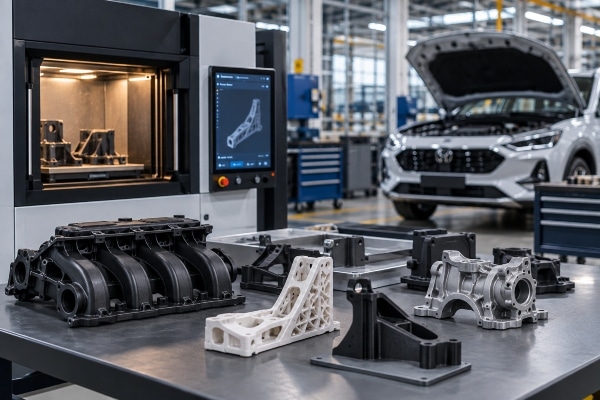
Zeal 3D runs five plastic 3D printing processes (FDM, SLA, SLS, MJF, PolyJet) plus metal DMLS/SLM printing in-house, covering a similar spread to Hyundai’s own polymer-and-metal lineup for the applications that matter most to automotive customers:
- Prototyping and design validation, quoted and shipped without a sales call.
- Jigs, fixtures, and production tooling, printed instead of machined, and iterated cheaply as a design changes.
- Discontinued and hard-to-source parts, reproduced from a scan, a drawing, or a sample part, the same problem the AMSC solved for the Hyundai Pony.
- Low-volume, performance-critical components, in engineering-grade and reinforced materials suited to load-bearing brackets, housings, and trim.
It’s worth being upfront about the gap: Hyundai’s wire-arc directed energy deposition, built for very large single-piece structural parts, isn’t a process Zeal offers, and large-format metal structural work of that kind sits outside what a service bureau typically covers. Where Zeal’s process lineup lines up well with the AMSC story is the higher-frequency, lower-volume end of automotive work: prototypes, tooling, service parts, and motorsport components, which is also where most Australian automotive businesses spend their manufacturing budget.
How Zeal 3D Supports Automotive Manufacturing in Australia
A facility like the AMSC works because of what sits behind it: the right mix of processes, materials, and quality control to match a part to the way it’ll actually be used. That’s the same thinking Zeal 3D applies to every automotive job, just delivered as a service rather than an in-house build:
- Two decades of manufacturing experience, not just printing. Zeal 3D also runs CNC machining, injection moulding, and casting in-house, so a jig, bracket, or housing gets matched to whichever process actually suits it, rather than being pushed onto a printer by default because that’s the only tool on hand.
- Five 3D printing processes and 45+ materials, including engineering-grade nylon, glass- and carbon-fibre-reinforced composites, PEEK and ULTEM for heat and chemical resistance, and metal DMLS/SLM for load-bearing or structural components, covering most of what an automotive prototype, tooling job, or low-volume part is likely to call for.
- No minimum order and no lock-in contract. A single replacement bracket and a fifty-unit production batch are quoted through the same transparent process, so on-demand parts don’t come with a volume penalty. For a sense of how pricing typically breaks down by technology, see Zeal 3D’s 3D Printing Cost in Australia guide.
- Trusted by organisations with serious engineering and QA standards, including CSIRO, BHP, Thales, and NSW Government among Zeal 3D’s client base, which is third-party proof that the quality discipline automotive parts demand isn’t a new ask.
- Fast, dependable turnaround. FDM parts typically ship within 24 hours; SLA, SLS, MJF, PolyJet, and metal DMLS/SLM generally within 5–6 working days, relevant when a jig is holding up a production line or a part is needed before a race weekend.
- Instant, file-based quoting with a process recommendation attached, so a workshop or engineering team doesn’t need in-house additive manufacturing expertise to work out which technology and material suit a given part. It’s the accessible version of the DfAM and quality-first thinking built into the AMSC.
Upload Your 3D File & Get a Quote · Speak to Our Team
Frequently Asked Questions
Q1. What is automotive additive manufacturing used for?
The main applications are vehicle development prototypes, manufacturing jigs and fixtures, service parts for discontinued or older vehicles, heritage and restoration components, and low-volume performance parts such as motorsport brackets and housings.
Q2. Can 3D printing replace tooling for jigs and fixtures?
Yes, for most jigs and fixtures. Printed tooling is typically faster and cheaper to produce than machined tooling, and easier to iterate when a design changes, though very high-wear production tooling may still be better suited to machined metal.
Q3. Can you 3D print a discontinued or hard-to-source car part?
In most cases, yes. A part can be reproduced from a 3D scan, an original drawing, or a physical sample, then printed in a material matched to its original function, without needing the original manufacturer or tooling.
Q4. Is 3D printing viable for motorsport parts?
Yes, particularly for brackets, housings, ducting, and other low-volume, performance-critical components where geometry and weight matter more than large production runs. Engineering-grade and reinforced materials are typically used for load-bearing motorsport parts.
Q5. What materials suit 3D printed automotive parts?
It depends on the job. Standard plastics such as PLA, ABS, and PETG suit concept models and low-load prototypes; engineering-grade nylon, polycarbonate, and TPU suit functional brackets and housings; glass- or carbon-fibre-reinforced nylon suits stiffness-to-weight applications; and PEEK or ULTEM suits parts needing heat or chemical resistance. Metal DMLS/SLM covers load-bearing or structural components.
Q6. Does Zeal 3D work with automotive businesses?
Yes. Zeal 3D supplies prototyping, jigs and fixtures, and functional parts to automotive customers across Australia using its plastic 3D printing service (FDM, SLA, SLS, MJF, PolyJet) and metal DMLS/SLM printing, quoted per job with no minimum order.
Get a Quote for Your Automotive Project
Whether it’s a prototype ahead of tooling, a jig for the production line, or a part for a vehicle nobody stocks anymore, Zeal 3D quotes automotive jobs individually against your actual file, material, and quantity.
Upload your file for an instant, no-obligation quote.
Sources: VoxelMatters: Hyundai and Kia open first dedicated additive manufacturing facility, Global Market Insights: Automotive 3D Printing Market, Mordor Intelligence: Automotive 3D Printing Market.